


🚚 Free shipping on $150+ 🛡️ Research-Grade Peptides • Laboratory Tested • 99%+ Purity 🔒 Secure Checkout • Fast & Discreet Shipping 🚚 Free shipping on $150+ 🛡️ Research-Grade Peptides • Laboratory Tested • 99%+ Purity 🔒 Secure Checkout • Fast & Discreet Shipping
Essential FOXO4-DRI: A Powerful D-Retro-Inverso Peptide for Senescence
FOXO4-DRI research explained: D-retro-inverso design, FOXO4–p53 interactions and the interpretation of senescent-cell studies.

FOXO4-DRI senolytic research peptide is worth understanding for its chemistry alone. Moreover, it is built backwards, from mirror-image amino acids, and still works. That design trick is called D-retro-inverso.
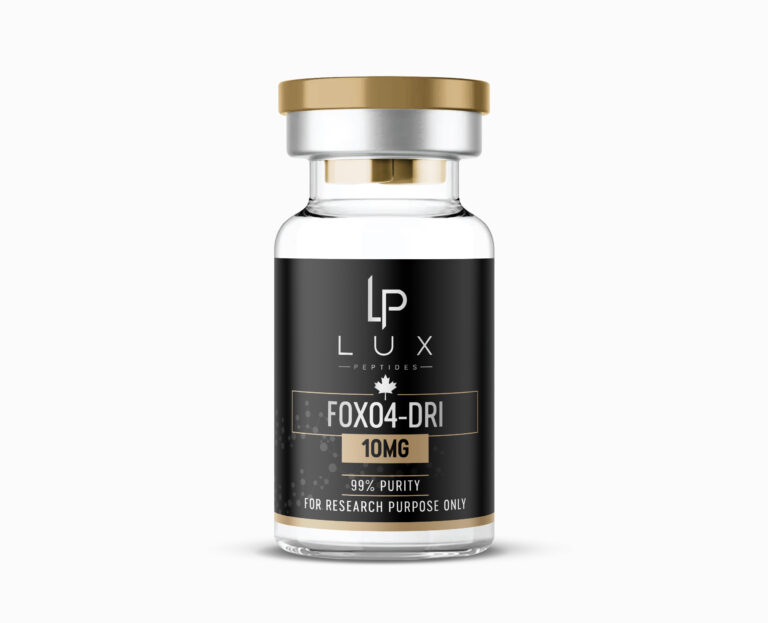
Quick facts
| Property | Detail |
|---|---|
| Design | D-retro-inverso peptide |
| Based on | FOXO4 transcription factor’s p53-interacting region |
| Research target | FOXO4-p53 protein-protein interaction |
| Research field | Cellular senescence, senolytics |
How D-retro-inverso design works
Reversing a peptide’s residue order and using D-amino acids can approximately preserve the spatial presentation of some side chains. This may increase resistance to many proteases, but binding and activity must be established experimentally for the resulting molecule.
The biology being tested
Senescent cells stop dividing but resist apoptosis.
One proposed reason is that FOXO4 binds p53 and holds it in the nucleus, preventing it from triggering cell death.
FOXO4-DRI was designed to compete for that interaction, releasing p53.
In published cell models, this has been reported to cause selective loss of senescent cells.
It leaves proliferating cells largely unaffected.
What laboratories study it for
Senescence-associated beta-galactosidase assays, apoptosis measurement in senescent versus proliferating cultures, FOXO4-p53 co-immunoprecipitation, and aging models.
Laboratory documentation and handling
Storage and handling requirements depend on the material, batch and analytical method. Consult the current product label, certificate of analysis and your laboratory’s validated procedures. Appearance alone does not establish identity, purity or stability.
Frequently asked questions
What does DRI mean?
D-retro-inverso: a reversed sequence built from D-amino acids.
What is a senolytic?
A compound studied for selective effects on the survival of senescent cells.
Why can a D-amino-acid design resist degradation?
Many proteases preferentially recognize L-amino-acid peptide backbones. FOXO4-DRI senolytic research peptide resistance depends on the molecule.
Related research material
View FOXO4-DRI at Lux Peptides for the current product description and available research formats.
For laboratory research use only. Not for human or veterinary use. Not approved by Health Canada for any therapeutic purpose.
