

🚚 Free Shipping on Orders Over $150 Across Canada 🛡️ Research-Grade Peptides • Laboratory Tested • 99%+ Purity 🔒 Secure Checkout • Fast & Discreet Shipping 🚚 Free Shipping on Orders Over $150 Across Canada 🛡️ Research-Grade Peptides • Laboratory Tested • 99%+ Purity 🔒 Secure Checkout • Fast & Discreet Shipping
Cartalax Revealed: The Essential AED Tripeptide in Connective Tissue
Cartalax (Ala-Glu-Asp) explained: a three-residue bioregulator studied in cartilage and connective tissue models, and how it fits the AED peptide family.

Cartalax is a three-residue peptide in the short-bioregulator literature. In Cartalax AED peptide research, it shares the Ala-Glu-Asp core. This core appears in related compounds, including Epitalon and Cardiogen.
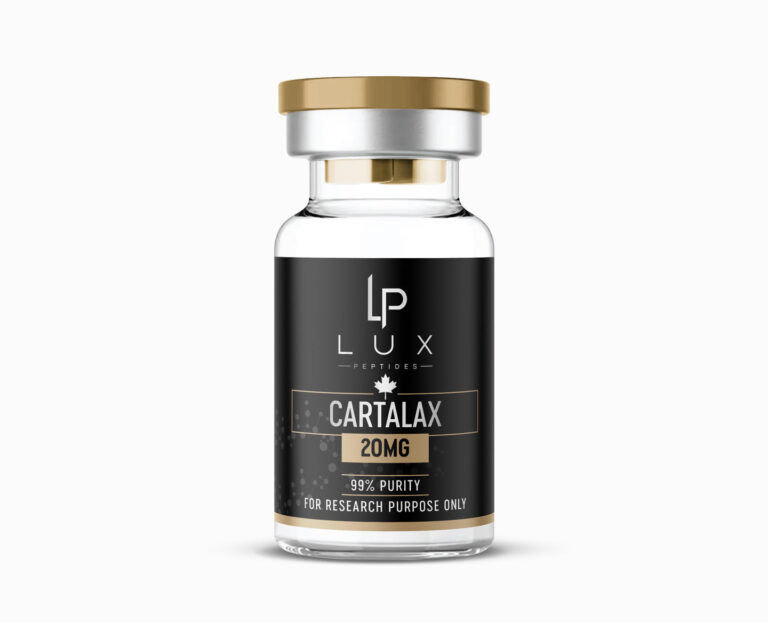
Quick facts
| Property | Detail |
|---|---|
| Sequence | Ala-Glu-Asp (AED) |
| Length | 3 amino acids |
| Family | Khavinson short peptide bioregulators |
| Research field | Cartilage and connective tissue models |
The shared AED core
Epitalon (AEDG), Cardiogen (AEDR) and Cartalax (AED) all build on the same three residues. In this research tradition the fourth residue, or its absence, is proposed to determine tissue specificity. Cartalax is the bare core.
What research reports
Studies describe effects on chondrocyte and fibroblast cultures and on tissue markers, including Cartalax AED peptide research as cartilage regulation.
As with the rest of the family, the literature is thin outside the originating groups.
A tripeptide’s sequence specificity in living cells is not established.
What laboratories study it for
Cartalax AED peptide research analyzes chondrocyte and fibroblast culture; extracellular matrix expression and family comparisons.
Laboratory documentation and handling
Storage and handling requirements depend on the material, batch and analytical method. Consult the current product label, certificate of analysis and your laboratory’s validated procedures. Appearance alone does not establish identity, purity or stability.
Frequently asked questions
Is a tripeptide still a peptide?
Yes, any chain of two or more amino acids qualifies.
What tissue is it associated with?
Cartilage and connective tissue in the published work.
Related research material
View Cartalax at Lux Peptides for the current product description and available research formats.
For laboratory research use only. Not for human or veterinary use. Not approved by Health Canada for any therapeutic purpose.