


🚚 Free shipping on $150+ 🛡️ Research-Grade Peptides • Laboratory Tested • 99%+ Purity 🔒 Secure Checkout • Fast & Discreet Shipping 🚚 Free shipping on $150+ 🛡️ Research-Grade Peptides • Laboratory Tested • 99%+ Purity 🔒 Secure Checkout • Fast & Discreet Shipping
Glutathione: The Essential Tripeptide at the Heart of Redox Research
Glutathione explained: the unusual gamma peptide bond, the GSH to GSSG couple, and why the ratio rather than the total is the meaningful measurement.

Glutathione is the most abundant thiol in the cell and one of the few peptides whose chemistry textbooks describe as unusual. The oddity is in the first bond.
Quick facts
| Property | Detail |
|---|---|
| Sequence | γ-Glu-Cys-Gly |
| Length | 3 amino acids |
| Unusual feature | Gamma peptide bond at the glutamate |
| Oxidised form | GSSG, two GSH joined by a disulfide |
| CAS number | 70-18-8 |
The gamma bond
In a normal peptide, bonds form between the alpha-carboxyl of one residue and the amino group of the next. In glutathione, glutamate contributes its side-chain carboxyl instead. That gamma linkage makes the molecule resistant to ordinary peptidases, which is part of why it can accumulate to millimolar concentrations inside cells.
The redox couple
The cysteine thiol participates in redox chemistry. Two GSH molecules can form GSSG through a disulfide bond, and glutathione reductase converts GSSG back to GSH using NADPH. Glutathione peroxidases and S-transferases use GSH in different reactions. Both the GSH:GSSG ratio and the measured concentrations can matter when interpreting cellular redox state.
What laboratories study it for
Oxidative stress assays, GSH:GSSG ratio measurement, glutathione peroxidase and S-transferase activity, and detoxification studies.
Laboratory documentation and handling
Storage and handling requirements depend on the material, batch and analytical method. Consult the current product label, certificate of analysis and your laboratory’s validated procedures. Appearance alone does not establish identity, purity or stability.
Frequently asked questions
Why is glutathione‘s bond unusual?
It uses the glutamate side chain rather than its alpha-carboxyl.
Should I measure total glutathione?
The GSH:GSSG ratio is more informative about redox state.
Why does it degrade?
The cysteine thiol oxidizes readily in air.
Related research material
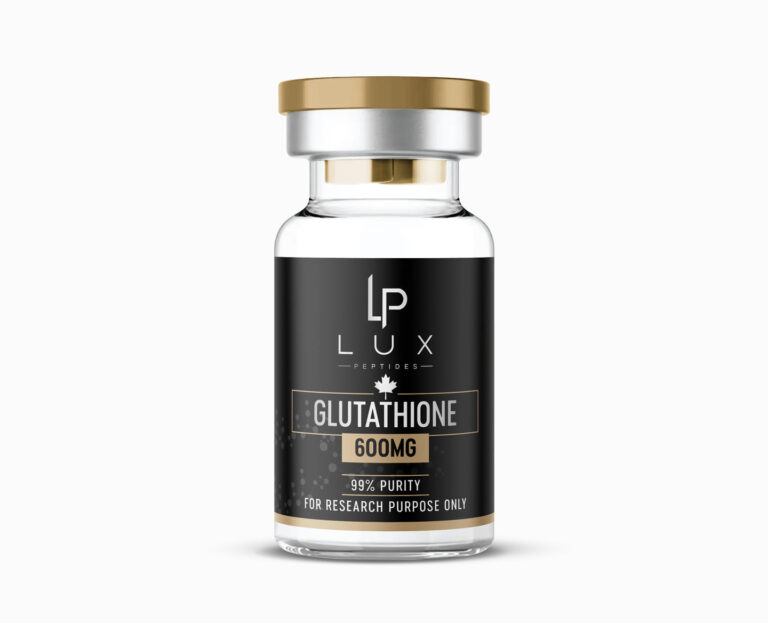
View Glutathione at Lux Peptides for the current product description and available research formats.
For laboratory research use only. Not for human or veterinary use. Not approved by Health Canada for any therapeutic purpose.
