

🚚 Free Shipping on Orders Over $150 Across Canada 🛡️ Research-Grade Peptides • Laboratory Tested • 99%+ Purity 🔒 Secure Checkout • Fast & Discreet Shipping 🚚 Free Shipping on Orders Over $150 Across Canada 🛡️ Research-Grade Peptides • Laboratory Tested • 99%+ Purity 🔒 Secure Checkout • Fast & Discreet Shipping
What Is Retatrutide? Inside the GIP, GLP-1 and Glucagon Triple Agonist
Retatrutide explained for researchers: its three receptor targets, lipidated 39-residue design, and laboratory documentation considerations.

Most incretin research peptides hit one receptor, some hit two. Retatrutide was engineered to activate three. That makes it a valuable tool for separating, and recombining, the effects of each receptor in metabolic signalling studies.

Quick facts
| Property | Detail |
|---|---|
| Development code | LY3437943 |
| Length | 39 amino acids |
| Receptor targets | GIPR, GLP-1R, glucagon receptor (GCGR) |
| Key modification | C20 fatty diacid side chain for albumin binding |
| CAS number | 2381089-83-2 |
| Molecular mass | approx. 4.7 kDa |
| Research area | Metabolism |
Why three receptors?
GIP and GLP-1 are incretin hormones released from the gut, and each has its own receptor. Glucagon acts on a third, related receptor that governs hepatic energy handling. Retatrutide‘s sequence borrows features from all three hormones, so a single molecule can activate each receptor with its own potency profile. In published receptor assays it shows strongest relative activity at GIPR.
Structure at a glance
The backbone includes non-standard amino acids such as Aib (α-aminoisobutyric acid), which protect the peptide from DPP-4 cleavage. A lipid side chain lets it bind serum albumin, which lengthens its persistence in experimental systems. This design approach is shared with tirzepatide and semaglutide, making the three a natural comparison set.
What laboratories study it for
- cAMP accumulation assays in cells expressing each receptor.
- Receptor selectivity and bias studies, comparing it with single and dual agonists.
- Preclinical models of energy expenditure and lipid metabolism.
The Lux Peptides research material is supplied for laboratory research only and must not be interpreted as a medicine or evidence of therapeutic suitability.
Laboratory documentation and handling
Storage and handling requirements depend on the batch and analytical method. Consult the product documentation, certificate of analysis and your laboratory’s validated procedures. Appearance alone does not establish identity, purity or stability.
Bacteriostatic water is listed in the Lux Peptides laboratory consumables catalogue. Its suitability depends on the requirements of the validated analytical method.
Frequently asked questions
How is retatrutide different from tirzepatide?
Tirzepatide targets two receptors (GIPR and GLP-1R); retatrutide adds the glucagon receptor.
Why is retatrutide lipidated?
The fatty acid side chain binds albumin, which extends its half-life in experimental systems.
Is Lux Peptides retatrutide supplied for therapeutic use?
No. Lux Peptides supplies this material for laboratory research only, not for human or veterinary use.
Related research material
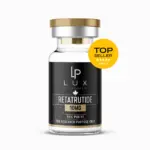
View Retatrutide at Lux Peptides for the product description and available research formats.
For laboratory research use only. Not for human or veterinary use. Lux Peptides products are not drugs, health products or supplements and are not approved by Health Canada for any therapeutic purpose.