

🚚 Free Shipping on Orders Over $150 Across Canada 🛡️ Research-Grade Peptides • Laboratory Tested • 99%+ Purity 🔒 Secure Checkout • Fast & Discreet Shipping 🚚 Free Shipping on Orders Over $150 Across Canada 🛡️ Research-Grade Peptides • Laboratory Tested • 99%+ Purity 🔒 Secure Checkout • Fast & Discreet Shipping
Proven Power of GHK-Cu Copper Tripeptide in Research
GHK-Cu explained: copper binding by a three-residue peptide, its discovery in human plasma, and the laboratory research it has prompted.

GHK-Cu copper peptide research shows it is one of the smallest bioactive peptides.
Three amino acids hold a single copper ion, a finding highlighted in GHK-Cu copper peptide research.
In GHK-Cu copper peptide research, its size eases synthesis and characterization, and copper chemistry remains compelling.
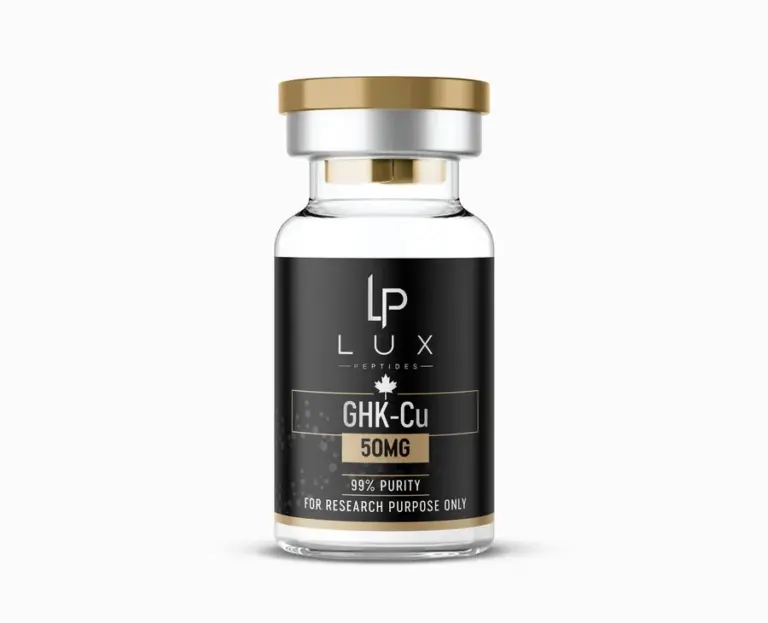
Quick facts
| Property | Detail |
|---|---|
| Sequence | Gly-His-Lys (GHK), complexed with Cu(II) |
| Length | 3 amino acids |
| CAS number (copper complex) | 49557-75-7 |
| Appearance in solution | Blue, from the copper ion |
| First described | 1973, isolated from human plasma |
| Research area | Cellular ageing |
Discovery
GHK was identified in the early 1970s during work on human plasma, when researchers noticed a fraction that changed how liver cells behaved in culture. The active factor turned out to be the tripeptide Gly-His-Lys, which binds copper(II) with high affinity. Plasma levels of GHK were later reported to fall with age, which drew it into aging research.
How the copper complex works
The histidine side chain and the peptide’s backbone nitrogens hold the copper ion. This places it in a stable square-planar arrangement. This supports GHK-Cu copper peptide research by showing it acts as a copper carrier. It delivers the metal to cells in a controlled form. Research has looked at:
- Collagen and glycosaminoglycan synthesis in fibroblast cultures.
- Copper transport and antioxidant enzyme activity.
- Large gene-expression datasets, where GHK has been reported to shift the activity of many genes at once.
What laboratories study it for
GHK-Cu copper peptide research supports fibroblast and keratinocyte culture.
It supports extracellular matrix studies, metal-coordination chemistry, and gene-expression profiling.
It is also a component of multi-peptide research blends such as GLOW.
Laboratory documentation and handling
Storage and handling requirements depend on the batch and analytical method. Consult the product documentation, certificate of analysis and your laboratory’s validated procedures. Appearance alone does not establish identity, purity or stability.
Bacteriostatic water is listed in the Lux Peptides laboratory consumables catalogue. Its suitability depends on the requirements of the validated analytical method.
Frequently asked questions
Why is GHK-Cu blue?
The color comes from the bound copper(II) ion.
Is GHK the same as GHK-Cu?
GHK is the bare tripeptide; GHK-Cu is the same peptide with copper bound to it.
Sources and further reading
- Pickart and Thaler (1973) — original plasma-tripeptide research — Original cell-culture research.
- Lau and Sarkar (1981) — copper binding by GHK — Original coordination-chemistry study.
Related research material
View GHK-Cu at Lux Peptides for the product description and available research formats.
For laboratory research use only. Not for human or veterinary use. Lux Peptides products are not drugs, health products or supplements and are not approved by Health Canada for any therapeutic purpose.