

🚚 Free Shipping on Orders Over $150 Across Canada 🛡️ Research-Grade Peptides • Laboratory Tested • 99%+ Purity 🔒 Secure Checkout • Fast & Discreet Shipping 🚚 Free Shipping on Orders Over $150 Across Canada 🛡️ Research-Grade Peptides • Laboratory Tested • 99%+ Purity 🔒 Secure Checkout • Fast & Discreet Shipping
Ultimate Guide to BPC-157: The Gastric Pentadecapeptide
BPC-157 explained for Canadian labs: its 15-residue sequence, gastric origin, research into signalling pathways, and batch documentation.

Few research peptides generate as many questions as BPC-157 research peptide Canada. It is short, unusually stable, and has been the subject of a large body of preclinical literature. This guide sets out what the compound actually is, where it came from, and what laboratories use it to study.
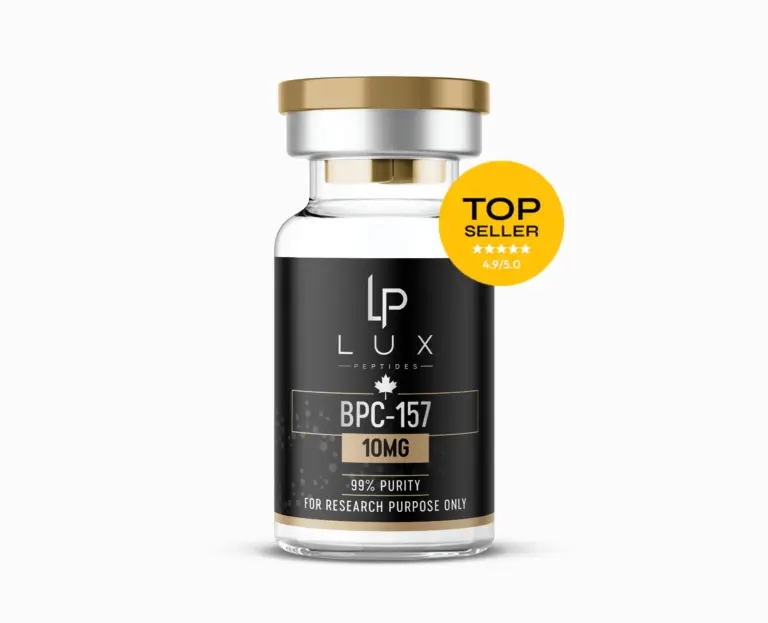
Quick facts
| Property | Detail |
|---|---|
| Full name | Body Protection Compound-157 |
| Length | 15 amino acids (pentadecapeptide) |
| Sequence | Gly-Glu-Pro-Pro-Pro-Gly-Lys-Pro-Ala-Asp-Asp-Ala-Gly-Leu-Val |
| Molecular weight | approx. 1419.5 g/mol |
| CAS number | 137525-51-0 |
| Form supplied | Lyophilised powder |
| Research area | Tissue repair signalling |
Where BPC-157 comes from
BPC-157 is a synthetic fragment. Its sequence was taken from a larger protein first isolated from human gastric juice. Researchers named it body protection compound. The 15-residue stretch was made synthetically so it could be studied on its own. The BPC-157 research peptide Canada is a recognized descriptor for this synthetic fragment. Its proline-rich backbone helps resist breakdown in acidic conditions, something most peptides do not tolerate well.
How researchers think it works
No single receptor has been confirmed for BPC-157, which is part of what makes it an active research topic. Published work has looked at three main areas:
- Angiogenic signalling: studies have reported effects on VEGFR2 expression and downstream pathways in endothelial cell models.
- Cell migration: fibroblast and tendon-cell assays have examined how it affects spreading, focal adhesion kinase activity and outgrowth.
- The nitric oxide system: several papers explore interactions with NO synthesis pathways.
Most of this evidence comes from cell culture and rodent models. Controlled human data remain limited, so the compound should be treated as investigational.
What laboratories study it for
In Canada, the BPC-157 research peptide Canada is used as a tool compound in wound-healing scratch assays.
It is also used in endothelial tube-formation assays and models of tissue injury signalling.
Labs often pair it with TB-500 to compare two repair-related mechanisms in the same model.
Laboratory documentation and handling
Storage and handling requirements depend on the batch and analytical method. Consult the product documentation, certificate of analysis and your laboratory’s validated procedures. Appearance alone does not establish identity, purity or stability.
Bacteriostatic water is listed in the Lux Peptides laboratory consumables catalogue. Its suitability depends on the requirements of the validated analytical method.
Frequently asked questions
Is BPC-157 a natural peptide?
It is a synthetic peptide whose sequence was derived from a naturally occurring gastric protein.
Why is BPC-157 described as stable?
Its proline-rich sequence resists enzymatic and acidic degradation better than most short peptides.
Where can Canadian laboratories find BPC-157 product details?
The BPC-157 product page lists the available research material. Confirm current availability and shipping options when placing an order.
Related research material
View BPC-157 at Lux Peptides for the product description and available research formats.
For laboratory research use only. Not for human or veterinary use. Lux Peptides products are not drugs, health products or supplements and are not approved by Health Canada for any therapeutic purpose.